Pchum Ben in Phnom Penh: Where to Eat When the City Goes Home
Before dawn on the last days of Pchum Ben, Phnom Penh's pagodas fill with families scattering rice for the wandering dead, while the streets outside quietly empty. Here is what the festival means, what gets cooked for it, and where to eat while half the city is in the provinces.
The Pchum Ben festival, this year falling in early October, is traditionally a quiet lull in the city's constant hum. The traffic thins. Shutters come down on noodle shops that have not closed in months. The tuk-tuk drivers who usually crowd the corner of Street 51 have gone home to Takeo and Kampong Cham and Prey Veng, and the city takes on a stillness that feels almost borrowed. Long before sunrise, the pagodas fill instead: grandmothers in white blouses, children half-asleep on their parents' shoulders, the low murmur of chanting drifting out over courtyards lit by candles and incense.
It is the most important religious festival in the Khmer calendar and the one most visitors understand least. Rather than a celebration in the way Khmer New Year is, it is an obligation, a reunion and an act of remembrance all at once, and it shapes how the whole country eats, travels and works for the better part of a month.
In 2026, the three-day public holiday falls on Saturday 10 to Monday 12 October, with the commemoration of the late King Father following on Thursday 15 October. For anyone hoping to eat out in Phnom Penh that week, a little planning goes a long way.
Fifteen Days for the Dead
Pchum Ben runs for fifteen days during the waning moon of the Khmer month of Phatrabot. The belief at its heart is that, during this fortnight, the gates of the underworld open and the spirits of the dead return to walk among the living. Some are ancestors looking for their families. Others are preta, the hungry ghosts, souls whose misdeeds in life left them unable to eat or drink, and who depend entirely on the merit and food offered by the living.
The first fourteen days are known as Kan Ben. Families take turns bringing food to their local pagoda, with households within a community each assigned a day so that the monks are fed throughout. The fifteenth day is Pchum Ben proper. Pchum means to gather, and on this day the whole community comes together at once, often visiting several pagodas in a single day. Folk belief holds that a spirit will search up to seven pagodas for offerings from its relatives, and that one which finds nothing may leave disappointed, or worse.
The festival's roots are generally traced to Buddhist texts on the hungry ghosts, including the story of King Bimbisara, whose departed relatives appeared to him as suffering spirits until merit was properly dedicated to them. Over centuries, that teaching settled into far older Khmer traditions of ancestor veneration, and the result is something distinctly Cambodian. Pchum Ben is also, practically speaking, the great homecoming of the year. Garment workers, students and office staff travel back to their home provinces, which is why Phnom Penh empties the way it does.
The Food of Pchum Ben
Every part of Pchum Ben is expressed through food. Feeding the monks is how merit is made, and the merit is what reaches the dead.
The most distinctive offering is bay ben: balls of sticky rice, sometimes mixed with sesame or coconut, carried to the pagoda before dawn and scattered or placed around the vihara for the spirits who have no family to feed them. It happens in the dark, around four in the morning, because the hungry ghosts are said to shy from daylight. Watching the courtyard of a neighbourhood wat in those hours, the ground slowly covering with small white offerings, is one of the quieter and more moving things the city offers.
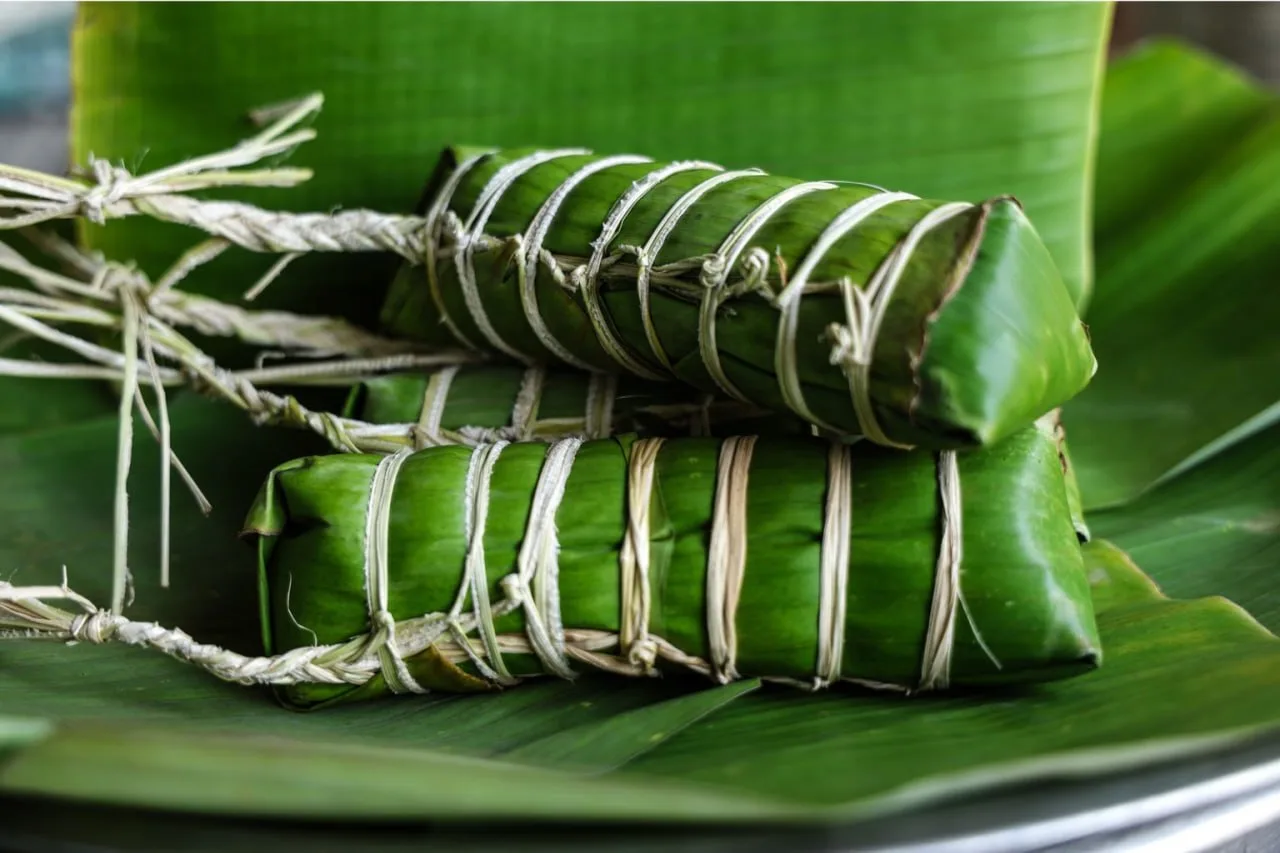
Then there is num ansorm, the food most Cambodians associate with the holiday. Sticky rice is packed around a filling of fatty pork and mung bean, or banana for the sweeter version, wrapped tightly in banana leaves and simmered for hours. Families make them in quantity the night before, often together, and they are eaten, shared and offered across the whole festival. Num kom, the small pyramid-shaped parcels filled with coconut and palm sugar, sit alongside them on the offering trays.
The monks' meal itself must be eaten before midday, so families arrive in the morning with stacked metal tiffin carriers holding curries, soups, fried fish, rice, fruit and sweets. Many cook the dishes their late parents or grandparents loved, which gives every household's offering a personal character no restaurant menu could reproduce. In the days before the holiday, the markets show it: banana leaves stacked in green walls, sacks of glutinous rice by the stall entrance, roadside vendors selling num ansorm by the bundle.
For a wider introduction to the dishes behind these offerings, the Cambodian food guide is the place to start.
A Fair Warning: Much of the City Will Be Closed
This is the part visitors and newer residents tend to learn the hard way. During Pchum Ben, a large share of Phnom Penh's restaurants, cafés and street stalls close, some for the three official days and many for longer. Family-run Khmer kitchens shut so their owners can go home. Noodle and rice stalls disappear. Even foreign-owned restaurants frequently close or run reduced menus, because their kitchens are staffed by Cambodians who have earned the time with their families.
Closures often begin a day or two before the official holiday and stretch beyond it, and with the King Father's commemoration falling the same week, some places will simply take the full stretch off. Markets thin out. Delivery apps run short of riders, and the riders who are working are busy. Posted opening hours on maps and websites are not reliable this week. If a meal matters, message or call ahead.
Where to Eat: The Hotel Rule
The most dependable rule of the holiday is simple. Hotels cannot close, because their guests are still in the building, and that means hotel restaurants and bars keep running when much of the city does not.
At the top end, the Rosewood's floors inside Vattanac Capital Tower stack several venues under one roof. Brasserie Louis on the thirty-fifth floor serves breakfast, lunch and dinner, with French classics alongside Cambodian dishes. Two floors up, Iza runs a robata grill and a sushi counter, while Sora pours from a whisky library that claims the largest single malt collection in the country. CUTS on Level 38 handles the dry-aged steak end of the evening. For something with more history, the Elephant Bar at Raffles Hotel Le Royal has been pouring drinks since 1929 and carries a gin list running past two hundred varieties, a reminder that this city has always needed somewhere to drink when everything else is quiet.
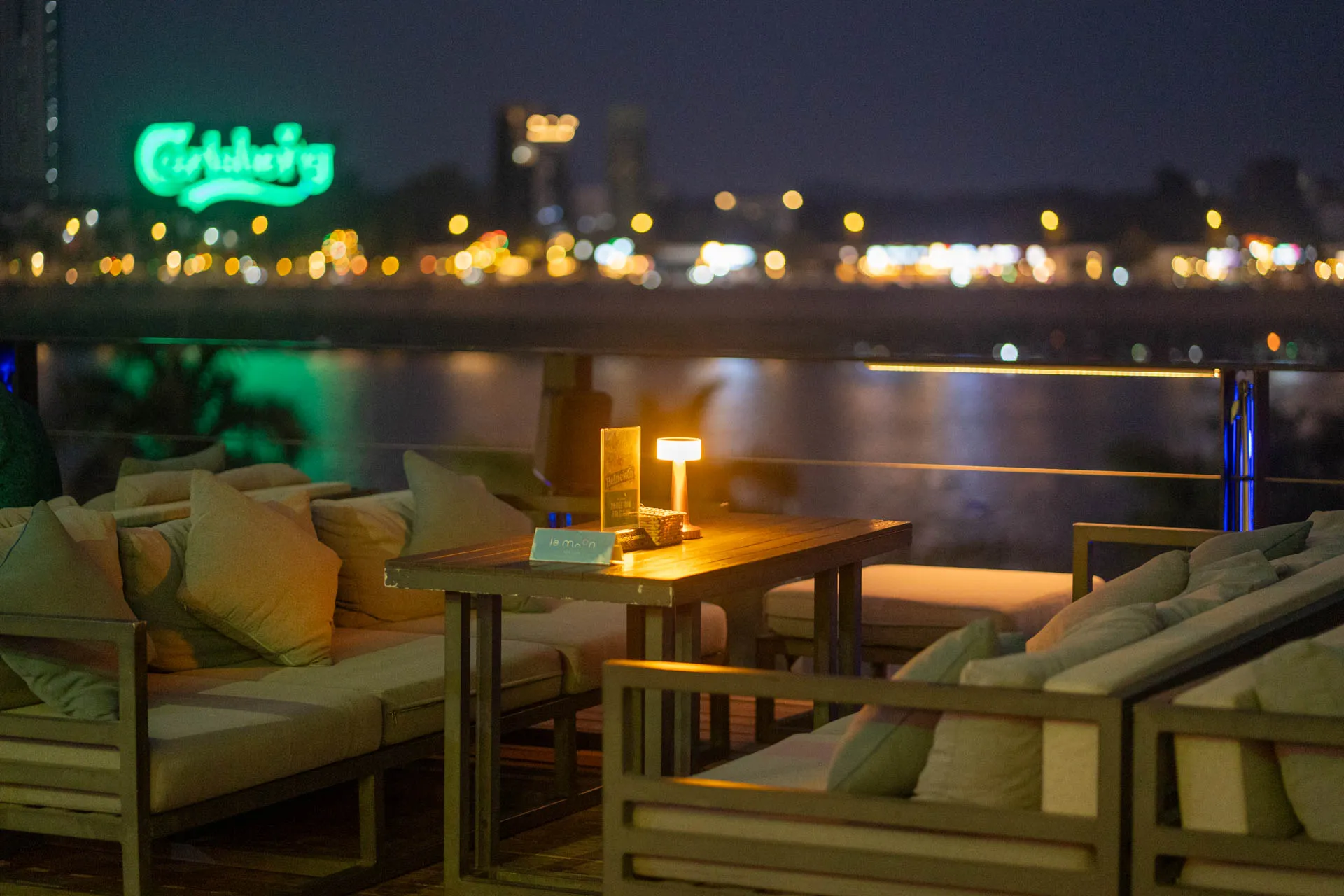
The middle of the market is where the holiday's most useful options sit. If the craving is specifically for Khmer food, the very thing hardest to find during Pchum Ben, Blossom Restaurant on the thirteenth floor of the Caravan Hotel keeps fish amok and beef saraman on the menu with the skyline as a backdrop. Near Post Office Square, Khmer Funk Sky Bar at the top of TRIBE serves grilled street-style bites with craft beer. On the riverside, Le Moon Rooftop has sat on the fifth-floor terrace of Amanjaya Pancam Suites since 2010, looking out over the meeting of the Tonle Sap and Mekong, and for later nights, Darlin' Darlin' inside NagaWorld keeps live music going into the small hours.
The rule works at the budget end too, because guesthouses have guests as well. A short walk north along Sisowath Quay, Bar Oz pairs its rooms with a twenty-four-hour bar, billiards, darts and a kitchen turning out full breakfasts, burgers and toasties, which makes it about the most dependable plate of food on the river at any hour of the holiday. Hostels follow the same logic. Tropico Bar & Bistro, the hostel on Street 172, keeps its bar and kitchen running through the holiday, with classic cocktails and live music on one of the city's most mixed nightlife strips.
That points to the other safe bet. The nightlife strips stay open through Pchum Ben, to some extent: Street 172, the riverside, Bassac Lane, Street 278 and Langka Lane will each see some bars and restaurants close while others stay open, so a drink and something to eat are never far away.
With so many kitchens closed, the places that stay open take the overflow. Book ahead for dinner, particularly over the holiday weekend itself.
Tips for Pchum Ben Week
The dates: The 2026 public holiday runs from Saturday 10 to Monday 12 October. Expect the city to be quietest from Friday afternoon through Monday, with a second lull around Thursday 15 October.
Visiting a pagoda: Visitors are welcome, but this is a religious occasion rather than a performance. Dress modestly with shoulders and knees covered, remove shoes where others do, and keep cameras discreet, particularly during the pre-dawn offerings.
Getting around: Tuk-tuks and ride-hailing drivers are scarcer, and fares rise accordingly. Roads out of Phnom Penh jam badly on the Friday before the holiday and on the day everyone returns.
Cash: With fewer businesses open and some ATMs running low over long weekends, keep dollars and riel on hand.
Check before you go: Use BongNham to find venues, then confirm by phone or message. This is the one week of the year when a closed door is the most likely outcome of turning up unannounced.
Pchum Ben is not a festival that puts itself on show for visitors, and it does not need to. It belongs to Cambodian families and their dead, and the empty streets are the clearest sign of how seriously it is kept. For anyone staying in the city, the week offers something unusual: a Phnom Penh slowed almost to a halt, pagodas glowing before dawn, and the smell of banana leaves and sticky rice drifting from kitchens all over town. Plan the meals, respect the mornings, and enjoy a calm that falls on the city but once a year.
Need somewhere open? Browse Khmer restaurants across the city on BongNham and call ahead, then pair this with our guides to the best Khmer food in Phnom Penh, the city's hidden rooftop bars and live music venues. Back to normal after the holiday? Our one day in Phnom Penh itinerary covers the city at full speed.