The Cambodian Food Guide: What to Eat in Phnom Penh, Dish by Dish
Cambodian food is quieter than its Thai and Vietnamese neighbours, built on freshwater fish, fermented prahok and fragrant kroeung paste. Here is the canon of dishes worth knowing, from fish amok to a bowl of kuy teav at dawn, and where to eat each one across Phnom Penh.
Cambodian food carries a reputation problem that has nothing to do with how it tastes. Wedged between Thailand and Vietnam, two of the most exported cuisines on earth, Khmer cooking has always been the quiet one in the room. It does not lean on the chilli heat that made Thai food famous, and it does not have the street-corner theatre of a Hanoi pho stall. What it has instead is depth: a foundation of freshwater fish from the Tonle Sap, the funk of fermented prahok running through everything like a bassline, and kroeung, the pounded paste of lemongrass, galangal, turmeric, kaffir lime and garlic that gives most Khmer dishes their particular perfume. The flavours are built on balance rather than shock. Sour, salty, sweet and bitter are held in tension, and Kampot pepper and a squeeze of fresh lime do a lot of the work that a Thai kitchen would hand to the chilli.
That restraint is exactly why the food rewards a little knowledge. A first-time visitor who orders only fish amok and a fruit shake has barely opened the door. The dishes worth chasing are often the ones that never make it onto a tourist menu: a bowl of kuy teav taken standing up at six in the morning, a plate of grilled pork over broken rice from a smoking street cart, the sharp jolt of a prahok dip that locals grew up on and most visitors never try.
Here is what to order, dish by dish, and where to eat each one properly in Phnom Penh. For the full picture of the city's best Khmer kitchens, this guide runs alongside our companion round-up of the best Khmer food in Phnom Penh.
Fish Amok
If Cambodia has a national dish, this is it. Amok is freshwater fish folded through a coconut and kroeung custard, thickened with egg, and steamed until it sets into something between a curry and a mousse. Done well it arrives soft and trembling in a banana-leaf cup, fragrant with kaffir lime and slightly bitter from the noni leaf that a traditional kitchen still insists on. Done badly it is a runny yellow soup with fish in it. The difference is entirely in the kitchen.
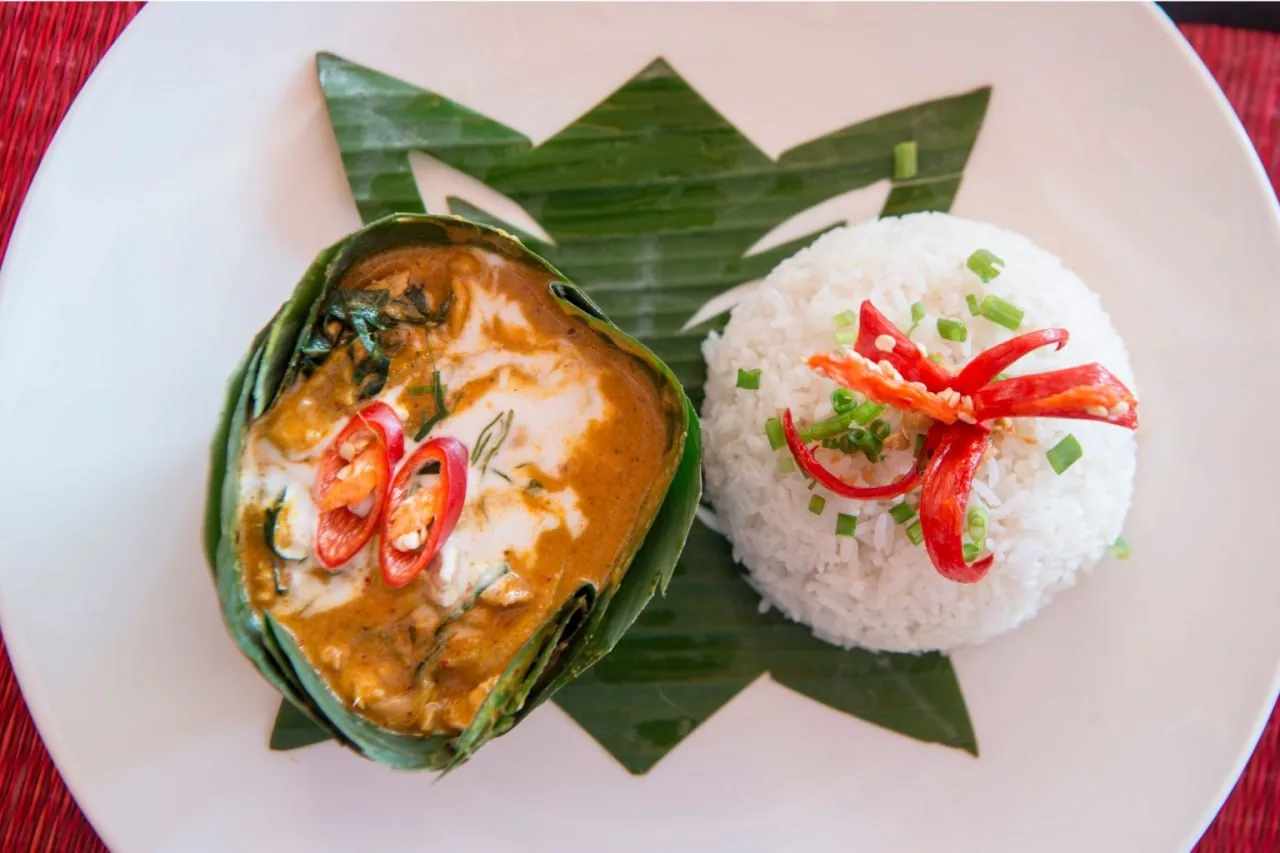
The benchmark version belongs to Malis (136 Norodom Blvd), the Cambodian fine-dining restaurant opened by master chef Luu Meng in 2004 and still the reference point for royal Khmer cooking in the city. This is amok treated as haute cuisine, plated with the seriousness the dish deserves. For a more relaxed room, Eleven One Kitchen (Street 460, Toul Tom Poung) turns out one of the best amoks in the city, cooked without MSG and with vegetables from its own rooftop garden. And for a modern Cambodian take on this traditional dish, head down the funky little alley that is Langka Lane to HoubHoub Cambodian Restaurant (BKK1), where fish amok sits among the signatures in a casual, affordable room. Amok appears on almost every Khmer menu in the city, but these are the kitchens that treat it as more than an obligation.
Beef Lok Lak
Ask a Cambodian for comfort food and lok lak is often the answer. Cubes or slices of beef are marinated and flash-fried, then served over lettuce and tomato with a soft fried egg on top and, crucially, a dipping sauce of lime, salt and black Kampot pepper on the side. The pepper sauce is the point. A good lok lak lives or dies on the sharpness of that little dish of lime and pepper, and the best kitchens grind the pepper to order.
Romdeng (corner of Street 240 and Street 55) serves exactly this kind of home-style Khmer cooking in a colonial villa, with air-conditioned rooms indoors and a lush garden outside that handles a long evening particularly well. For longevity, few can match Khmer Surin (Street 57), which has been serving Khmer and Thai food since 1996 across a few prior locations and remains one of BKK1's most dependable local tables. And Kinin (Street 123, Toul Tom Poung) folds a properly made lok-lak into a French-Khmer garden menu, a good option when half the table wants beef bourguignon and the other half wants to eat local.
Kuy Teav
The breakfast of the country. Kuy teav is a clear pork or beef bone broth, simmered long, poured over rice vermicelli and topped with sliced meat, meatballs, bean sprouts and a fistful of herbs, then finished by the eater with lime, chilli, fish sauce and sugar from the caddy on the table. It is a dish assembled as much by the diner as the cook, which is half the pleasure. Cambodians eat it early and fast, often standing.
The place to understand it is 126 Restaurant (Street 13 corner Street 136, Phsar Kandal), a Khmer breakfast institution that has run from the same corner since 1992 and opens as early as five in the morning. Its kuy teav sach ko, the beef version, is the dish the regulars have come for across three decades. For a different register of the same idea, Thmor Da on Kampuchea Krom Boulevard has served Cambodian-Chinese comfort food for decades and draws its own breakfast crowd for a deep pork-bone noodle soup. Both open early and do their best work before the lunch rush arrives.
Bai Sach Chrouk
Perhaps the most beloved everyday breakfast in Cambodia, and one of the simplest. Bai sach chrouk is thinly sliced pork, marinated in coconut milk or garlic and grilled slowly over charcoal until the edges char and caramelise, then served over broken rice with a bowl of clear broth and a small mound of pickled cucumber and ginger on the side. At its best it is a street-corner dish, cooked over a smoking grill from first light and gone by mid-morning. If you see a cart with a queue of Cambodians in front of it before eight, that is your breakfast.
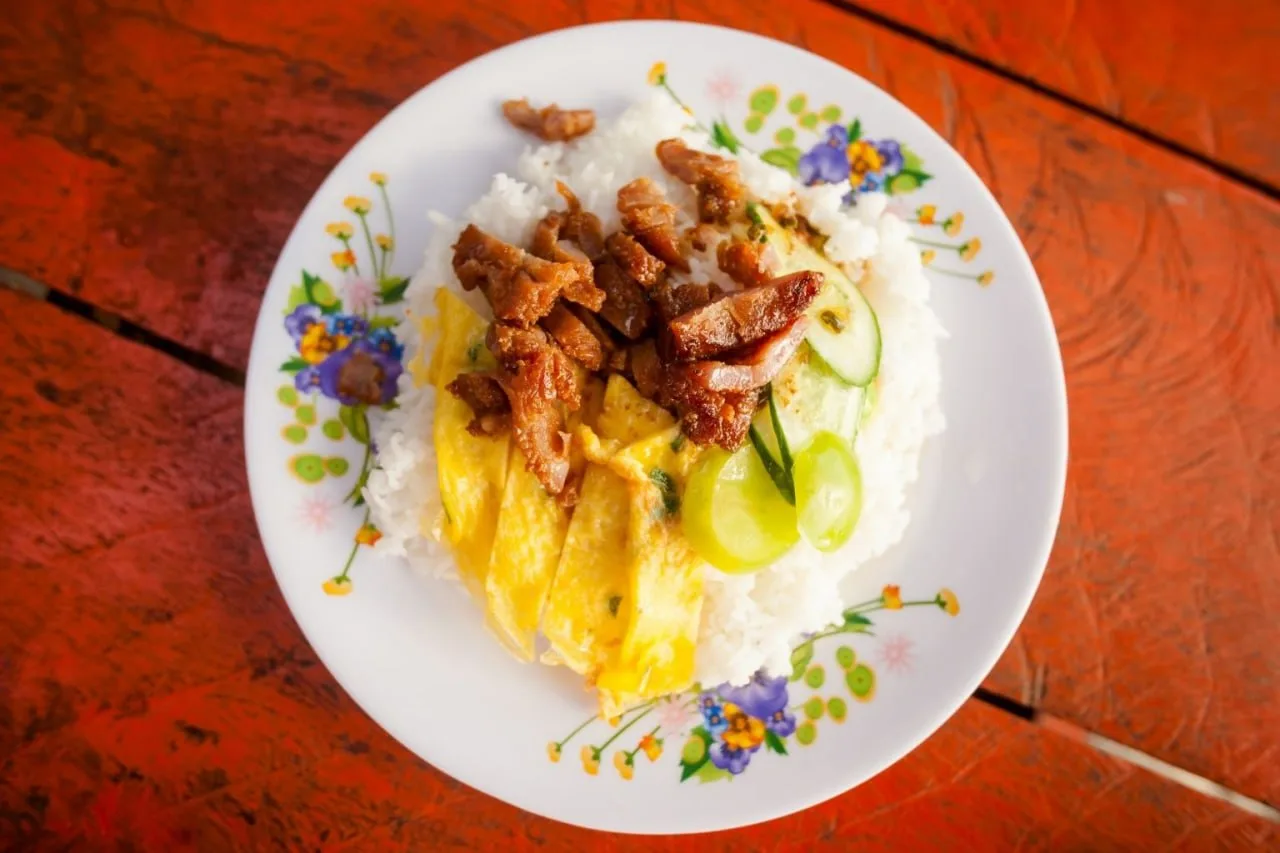
For a version you can sit down to, Khmer Women's Food (Abdul Carime Street, off Bassac Lane) serves a reliable bai sach chrouk among a menu of Khmer home cooking, prepared fresh through the day in a glass-fronted kitchen by the family-run, women-led team the restaurant is named for. It is the accessible way in to a dish that most visitors walk straight past on their way to something they already recognise.
Nom Banh Chok
Known to expats simply as "Khmer noodles", nom banh chok is breakfast and lunch in one bowl and about as traditional as Cambodian food gets. Soft, hand-pressed fermented rice noodles are laid in a bowl and drowned in a thin green fish gravy built on kroeung and often a little prahok, then piled high with raw vegetables: banana blossom, cucumber, long beans, water lily stems, bean sprouts and a great tangle of herbs. It is cooling, herbaceous and completely unlike anything on a Thai or Vietnamese menu.
Kroeung Khmer Restaurant (Street 290) leads its menu with num banh chok and does the traditional green-gravy version justice. For hand-pressed noodles made in-house, Khmer Noodles Restaurant (Street 264, near Wat Botum Park) is a family-run kitchen celebrated for exactly this, its noodles pressed fresh and served with the fragrant, herb-heavy accompaniments the dish demands. For the same dish in a very different room, Lumiere (Street 110, Daun Penh) serves a fine nom banh chok inside the striking Rubik's-cube of a building that doubles as a café, cinema and gallery, where it shares an all-day Khmer menu with freshly ground Cambodian coffee. It is proof the dish belongs on a design-forward table as much as a market bench. However, you will find some of the best versions at market stalls, where a single vendor may have made nothing else for twenty years.
Lort Cha
Street food at its most satisfying. Lort cha is built on short, fat rice pin noodles, stubby things that look a little like rice worms, stir-fried hard over a charcoal-heated griddle with beef, bean sprouts and chives, seasoned with dark soy and served with a fried egg on top and a saucer of chilli on the side. It is smoky, chewy and cheap, the kind of thing you eat perched on a plastic stool watching the cook work.
The specialist worth crossing town for is Sok Lang Lort Cha (Street 178, near the Royal Palace), a street-food institution that has built its name on this one dish, cooked fresh on traditional charcoal griddles with a glass of pressed sugarcane juice alongside. This is not restaurant food dressed up. It is the real thing, done by people who make it hundreds of times a day. The other place to find it is where most Cambodians eat it anyway, in the markets: the food court at Toul Tompong Market, the Russian Market, turns out lort cha alongside the rest of the local street food, cooked to order for a couple of dollars.
Samlor Korko
If amok is the dish Cambodia shows to visitors, samlor korko is the one it cooks for itself. Often called the national soup, korko is a thick, rustic stew of whatever vegetables the season offers, green papaya, pumpkin, long beans, eggplant, jackfruit seeds, bound together with ground toasted rice and kroeung and usually a little prahok, with fish or pork carrying the protein. It is humble, deeply savoury and about as far from tourist food as the Khmer kitchen gets.
Sleuk Chhouk (Street 228) is one place to try it: a traditional Khmer restaurant with floor seating and a picture-board menu, open from ten in the morning, where korko sits among a roster of classics that locals order without a second thought. For a kitchen that treats the soup as a specialty rather than one dish among many, Banteay Srey Restaurant (Preah Ang Eng Street, near the National Museum) builds its korko out with a generous assortment of fish and vegetables, served in a warm, modern room a short walk from the riverside. And at the top of the range, Malis plates korko as part of its royal Khmer menu on Norodom Boulevard, the rustic village soup rendered with fine-dining precision. Ordering it at any of them is a small statement that you have moved past the visitor menu.
Prahok
No ingredient defines Cambodian cooking more completely, or divides newcomers more sharply. Prahok is fermented fish paste, pungent and salty, and it is the seasoning that runs quietly beneath a huge share of Khmer dishes. Encountered head-on it is a different experience. Prahok ktis is the dish that makes the case: the paste cooked down with minced pork, coconut milk, kaffir lime and chilli into a rich dip, served with a platter of raw vegetables to scoop it up. Prahok is also the soul of the countryside grilled-meat-and-dip meal, where charred beef is dragged through a sharp fermented sauce.
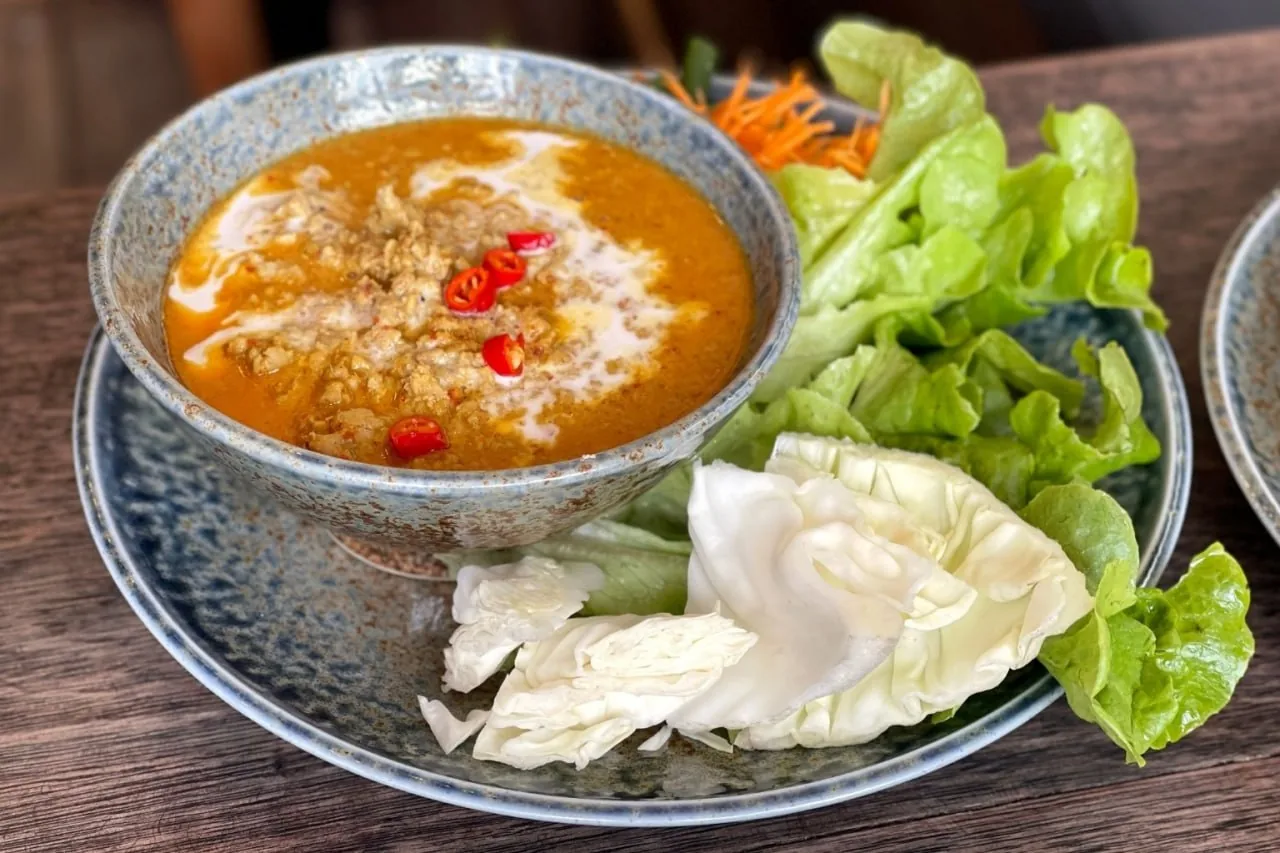
For prahok treated with real ambition, Penh House (Street 240, Daun Penh) runs a Prahok Discovery Set on its rooftop, a tasting menu built around the ingredient with views of the Royal Palace and Wat Botum, including a prahok-baked eggplant that converts sceptics. Malis, mentioned above for its amok, does a refined prahok ktis as part of its royal Khmer repertoire. And for prahok in its natural habitat, Sovanna II (Street 21, near the Independence Monument) is an evening-only charcoal grill that lights up at four and fills with local office workers pulling grilled beef and pork through a prahok dip late into the night.
Saraman Curry
A reminder that Cambodian food has more than one lineage. Saraman is the Khmer Muslim curry, a legacy of the Cham community, and a close cousin of Thailand's massaman: beef simmered slowly with coconut, peanuts and warm spices, star anise, cinnamon and cardamom, into something rich, sweet and gently aromatic rather than fiery. It is the dish to order when you want to understand that "Khmer food" is a wider category than the coconut-and-lemongrass shorthand suggests.
Blossom Restaurant (thirteenth floor of the Caravan Hotel, Street 228) runs a beef saraman among a menu that blends Cambodian flavours with a skyline view, a comfortable place to try the dish for the first time. For an even more upmarket experience, Mealea Restaurant (44 Sothearos Boulevard, corner of Street 240) plates a fine-dining Khmer beef shank saraman inside an eighty-year-old French colonial villa at the Palace Gate Hotel, royal Cambodian cooking at its most formal. Romdeng, mentioned above for its lok lak, also cooks a notable saraman.
Banh Chhev
The Cambodian answer to a savoury crepe, and a cousin of the Vietnamese banh xeo, though it is worth keeping the two straight. Banh chhev is a thin, crisp turmeric-yellow pancake, folded over bean sprouts, minced pork and sometimes shrimp, then torn into lettuce with herbs and dipped in a light sauce. The pleasure is textural: shatteringly crisp at the edges, soft in the middle, cool and green in the wrap.
Banh Chev Chnganh Chnganh has made the crisp pancake its whole identity, down to a name that says the banh chev here is delicious. It is the kind of single-minded specialist the dish rewards, turning out crisp, turmeric-yellow pancakes to a steady local crowd. Pile on the herbs and lettuce, dip it in the light sauce, and you have understood the format.
Num Pang
The Cambodian sandwich, and proof of what a French colonial legacy becomes when a local kitchen takes it over. Num pang is a short, airy baguette split and filled with pâté, cured and grilled meats, pickled vegetables, cucumber, chilli and a slick of sauce. It overlaps with the Vietnamese banh mi but has its own accent, and at its best it is one of the great cheap breakfasts anywhere.
1987 Pang & Cafe (Street 130) has made the num pang its whole identity, crisp baguettes with bold fillings alongside a lineup of inventive iced coffees, salted and egg and coconut, in an air-conditioned room built for the heat. Nearby on the same street, BanhSong Deli grounds its Cambodian-Vietnamese menu in the same tradition, a useful stop when lunch is more errand than occasion. Thmor Da, the noodle-soup institution mentioned earlier, also does a well-regarded num pang with ham and pâté for those already in its orbit at breakfast.
And to Finish: Cambodian Sweets
Khmer desserts are their own quiet world, and a full account deserves more room than a savoury guide allows. The short version: look for num, the broad family of sweet cakes and snacks, and the various che-style bowls of sweet soup layered with beans, jelly, sticky rice and coconut cream over ice. Sticky rice steamed in bamboo, ripe mango with sweet coconut rice, and pumpkin custard set with palm sugar are the ones to start with, and the best of them are still found at market stalls and street carts rather than restaurants. For a fuller tour of where the city's sweet tooth is best satisfied, our Phnom Penh dessert guide picks up where this leaves off.
How to Order Like a Local
Go early for the breakfast dishes. Kuy teav, bai sach chrouk and nom banh chok are morning food, cooked fresh and often sold out by mid-morning. The versions worth eating are gone by the time a late riser surfaces.
Order the dish the place is known for. A kitchen that has cooked one thing for thirty years will beat a broad menu every time. Chase the specialists: lort cha where they make only lort cha, amok where the chef treats it as art.
Do not skip the prahok. The single dish that separates a curious eater from a passive one is a prahok dip. Start with prahok ktis, which softens the intensity with coconut and pork, before working up to the uncooked dip served alongside charred grilled meat.
Look past the restaurant. Some of the best Cambodian food in the city is cooked on a cart or a market stall by someone who speaks no English and keeps no menu. A queue of locals is the only recommendation you need.
Cambodian food does not perform for you the way its neighbours do. It asks a little patience, a willingness to try the fermented and the unfamiliar, and the good sense to eat where Cambodians eat rather than where the menu has a photograph for every dish. Give it that, and the reward is a cuisine with more range and quiet confidence than its reputation ever promised: a bowl of noodle soup at dawn on a Phsar Kandal corner, a soft-set amok in a fine-dining garden, a plate of grilled pork and rice eaten off a plastic stool as the city wakes up. Start with the dishes above, and the rest of the country's table opens up from there.
Cover photo: Lort Cha, Phnom Penh