French Restaurants in Phnom Penh: Where the Colonial Kitchen Went Next
The baguette on every street corner is the obvious inheritance. The less obvious one is a French dining scene (bistros, brasseries, wine cellars and one revolving prime rib room) that runs deeper in Phnom Penh than in almost any city its size in Asia.
France left Cambodia in 1953, and left the bread behind. Anyone who has bought a num pang from a cart on Street 63 has eaten the evidence: a baguette, split and filled with pâté, pickled vegetables and chilli, sold for a dollar to people who have never given a moment's thought to where the loaf came from. That is the deepest kind of culinary influence, the sort that stops being foreign.
What is less widely understood is that the formal version survived too, and has been quietly compounding ever since. Phnom Penh has more serious French restaurants than any city of its size in Southeast Asia has a right to. There are bistros that opened in the nineteen-nineties and never moved. There are brasseries with their own butchers. There is a chef who trained alongside Paul Bocuse, another from the Bocuse institute, and a former French embassy chef who got tired of shopping for ingredients and bought a farm. The French community here is small and the Cambodian appetite for French food is real, and between them they have sustained something that most cities have to import.
This is not, therefore, a colonial curiosity. It is a working cuisine with its own hierarchy, from a garden lunch behind the Institut français for the price of a market meal, to a set menu on Norodom Boulevard that has been refined over the better part of thirty years. Here is how the city's French dining divides, and where to eat at each level of it.
The Institutions
Some of these restaurants have outlasted governments. That is worth saying plainly, because in a city where kitchens turn over every eighteen months, longevity is the only credential that cannot be manufactured.
TOPAZ (162 Norodom Boulevard) is the summit, and has been for the better part of three decades. The cooking is classical French without apology, a Salade Fernand Point built around foie gras and quail eggs, a Miyazaki wagyu set for those inclined, a tarte tatin that arrives the way a tarte tatin ought to. The wine cellar is the most serious in the country and the kitchen sources globally without pretending otherwise. Set menus begin around thirty dollars, which for the standard of cooking is one of the more remarkable pieces of value in Phnom Penh. It is on the World's 50 Best Discovery list, and it has earned the position slowly.
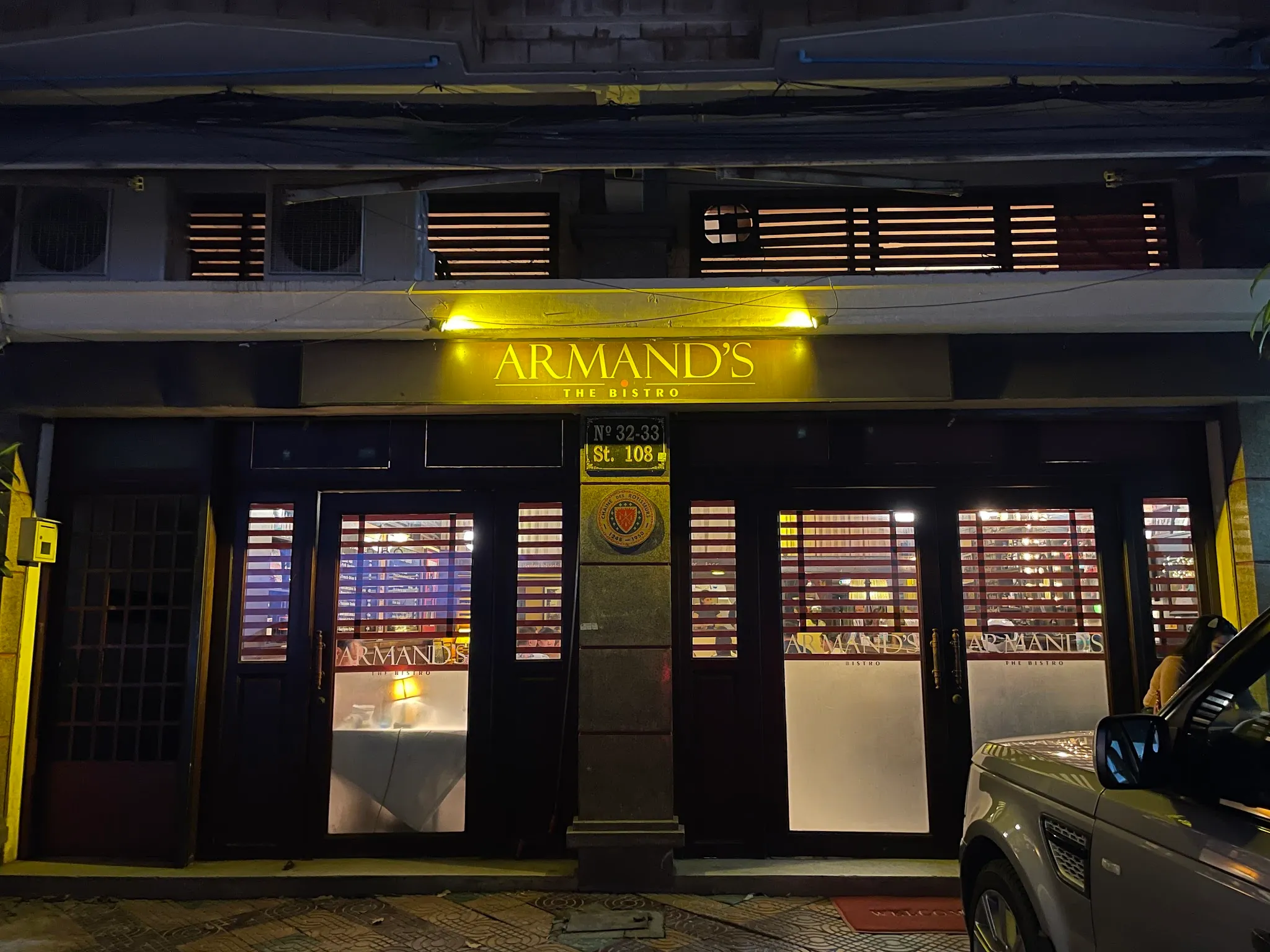
Armand's (33, Street 108, Rue Pasteur) is the other side of the same era, a small, dark, unrepentantly traditional bistro that has been in BKK1 since the nineteen-nineties and is reputed to be a favourite of the Cambodian royal family. The menu is short and does not move: Tournedos Rossini, Chateaubriand Béarnaise, pepper steak, French onion soup, Baked Alaska. It opens at six in the evening and it does not do lunch, which tells you what kind of restaurant it intends to be. Book. The room seats very few people and the regulars have first claim on them.
Further along Norodom, near Independence Monument, 1995 Atmosphère Bistrot (141 Norodom Boulevard) carries its founding year in its name, which saves everyone a conversation. The kitchen buys organic produce daily and cooks the bistro canon with it, petit salé with green lentils, couscous, an andouillette from Troyes that is not for the tentative. Thirty years in the same trade in Phnom Penh is not a marketing line. It is a fact that has to be earned every year.
The Bistros
The bistro is where French food in this city actually lives, one room, one kitchen, a chalkboard that changes, a wine list that fits on a page. These are the tables to know.
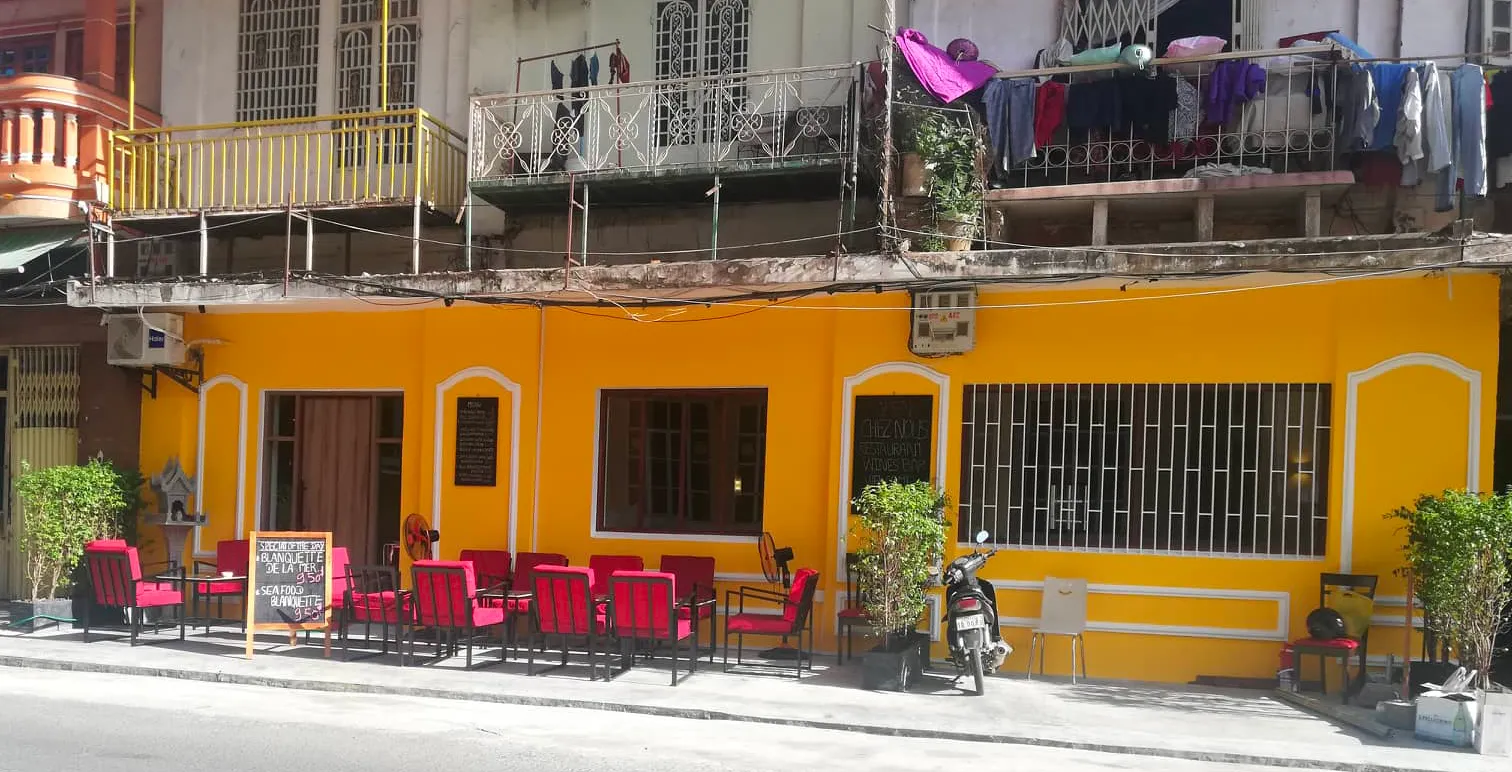
Bistrot de la Poste (24Eo Preah Ang Non, Street 102) sits a short walk from the old Central Post Office in Daun Penh, in a room of wooden beams and accumulated bric-à-brac that would be a set-dressing exercise anywhere else and here is simply what the building looks like. The daily specials rotate (moules frites when the mussels are right) and the fixed menu holds the line on steak tartare, coq au vin, duck confit and an andouillette. There is a cheese platter and a French wine list, and the whole operation runs Tuesday to Saturday, which is the schedule of a kitchen that intends to be good rather than available.
Pépé Bistro (223 Street 13) is the modern answer, opened in 2018 near the National Museum by Chef Aude Moulard, a graduate of the Institut Paul Bocuse. The à la carte changes every three months and the kitchen makes its own cheese, which is a sentence that ought to stop a reader in a city where the cheese is nearly always in a crate on a boat. Ink calamari, tuna carpaccio, pistachio-crusted lamb chops, squid with chorizo over squid-ink rice, the register is bistro, the technique is not casual.
La Taverne Royale (137 Khemarak Phoumin Avenue, Street 130) sits near the National Bank and is the most formal of this group. Chef Benjamin Armand trained alongside Paul Bocuse, and the menu makes the lineage explicit: house-made foie gras, escargots, braised Angus, and bone-marrow cromesquis, garlic-infused marrow crumbed and fried until gold, which is the sort of dish that only appears when a kitchen has confidence to spare. Crème brûlée to finish, as it should be.
Two more deserve knowing, and they sit at opposite ends of the register. Le deli bistro gourmet (13 Street 178) is bistronomy done seriously in an intimate room, the menu turns over weekly, the sauces are the point, and the mastery is in the meat cookery. And Haven Bistro (15A Street 450), up in Toul Tom Poung, is the neighbourhood version of the same instinct: French onion soup, croque madame, duck confit with whatever the vegetables are that week, a terrine with cornichons, a chocolate fondant. Home cooking with a French soul, which is a harder thing to pull off than fine dining, because there is nowhere to hide.
Down on Street 240, Baldwin's Bistro (52C Oknha Chhun Street, Street 240) splits itself in two (a casual bistro downstairs, a more considered dining room above) and bakes its own charcoal bread, which arrives black and startling and then makes complete sense with the beef carpaccio. And near the riverside, Chez Cri-Cri (30 Street 110) keeps the format small and the classics intact: boudin maison avec deux pommes, foie de veau, escargots de Bourgogne. It stays open until midnight, which few kitchens in this category bother to do.
The Brasseries and the Delis
The brasserie is a different proposition: bigger, louder, open all day, and (in Phnom Penh) usually attached to a counter selling the things it cooks with. This is where the French kitchen becomes a shop.
Khéma Pasteur (163 Street 51, corner Street 228) and Khéma La Poste (41 Street 13) are the Thalias group's twin brasseries, and between them they have done more to normalise French food in Phnom Penh than any other pair of addresses. The formula is the same at both, coq au vin, steak frites, Toulouse sausage with smashed potato, a charcuterie and cheese counter you can shop from on the way out, croissants and éclairs from a bakery that supplies the room. La Poste occupies a restored colonial building near Wat Phnom and serves Khmer dishes alongside the French, including a fish amok, at prices that sit around eight to fifteen dollars. There is a third branch on the twenty-eighth floor of the Flatiron at Khéma (Meridian, Phnom Penh City Center) for anyone who wants the same charcuterie board with the city underneath it.
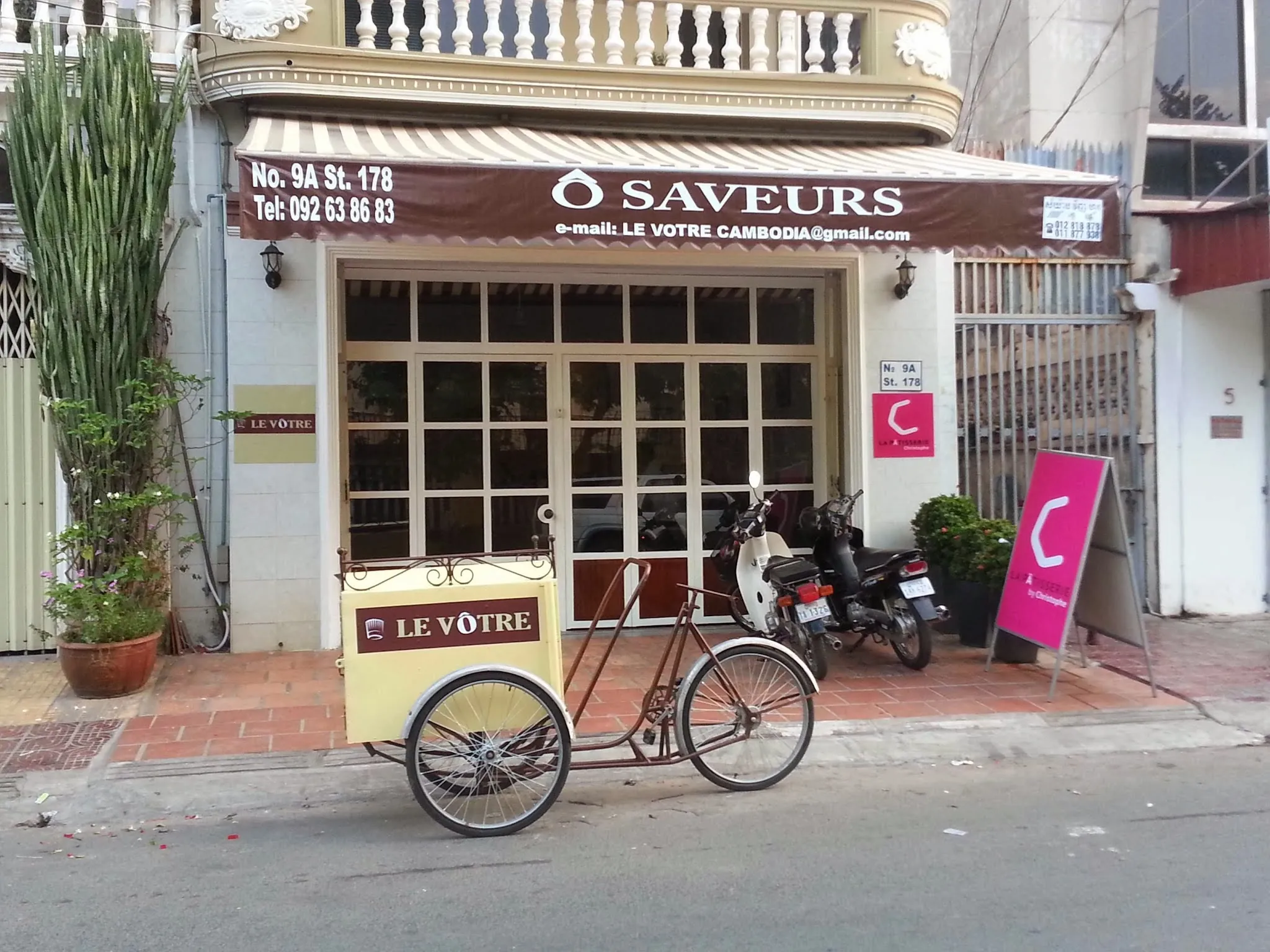
La Ferme de Bassac (9A Street 178) was opened in 2011 by a former chef of the French Embassy, and it solves the supply-chain problem in the most direct way available: the farm is theirs. The meat comes from it, the butcher works on site, the charcuterie is made in-house, the cheese has its own counter and the bakery turns out bread and croissants every morning. The result is a brasserie where the provenance question simply does not arise. Steak with a proper sauce, duck confit, a croque monsieur that has no business being as good as it is.
At the grander end, LA COUPOLE (Old August Site, 26 Samdach Sothearos Boulevard) is Sofitel's signature brasserie, a wood-panelled, high-ceilinged room modelled on the Montparnasse original, built for the seafood buffet, the butcher's buffet, and a Sunday Champagne brunch that has become one of the city's fixed social appointments. And Le Phnom 1929 (92 Rukhak Vithei, Raffles Hotel Le Royal) takes its name from the year the hotel opened and keeps the brasserie register accessible despite the address: seafood tower, Dover sole, veal paillard, prime cuts, an open kitchen, and a burger that hotel bars in this class rarely admit to serving.
The Fusion and the Views
The most interesting French cooking in Phnom Penh is not always the most orthodox. Several kitchens here have concluded (reasonably) that if you are going to cook French food in Cambodia, you might as well cook it with what Cambodia has.
Le Langka (132 Z13, Rue Pasteur, Street 51) sits near Wat Langka and runs a short menu of French dishes bent gently toward Asia, tuna tataki, beef tataki, sea bass tartare, duck breast, a coconut pavlova that closes the argument. The following it has built among the city's more attentive eaters is the kind that takes years and cannot be bought. It opens at six for dinner only.
Au Marché (123 Preah Ang Yukanthor Street, Street 19) is on the sixth floor with no signage at street level, which is either an inconvenience or the point depending on temperament. Two French owners, a weekly menu built on whatever the market gave up that morning, and a two- or three-course lunch set that is among the better-value French meals in the city. The cooking leans French with Asian inflection, fish carpaccio, chicken terrine, flank steak, tartare.
Restaurant Le Pavi (4a Street 600) is out in Toul Kork, arranged around a koi pond and a frangipani garden, and runs the neatest schedule in this guide: Khmer food until six in the evening, French thereafter. Foie gras terrine, steak tartare, lamb chops, couscous with merguez, and, on the Khmer side, a plear sat kho that earns its place on the same menu. Sit outside at sunset. That is what the garden is for.
Two rooms trade on altitude. Ruby Jack (42nd Floor, 83 Samdach Sothearos Boulevard) is Cambodia's only revolving dining room, and it exists to carve a seven-day dry-aged, seven-hour slow-roasted prime rib at the table while the city turns underneath, with a salade Lyonnaise, French onion soup and seared foie gras with oxtail keeping the French end of the bargain. LUMHOR (M Residence, 36th Floor, Street 282) takes the BKK1 skyline from a terrace bar with a menu that moves between Asian and Western plates and a cocktail list with genuine ambition. Both are, unavoidably, occasions. Price them accordingly.
For something quieter, Le Manolis (6 Street 13) occupies a restored colonial building near Wat Phnom and works best as a wine bar that happens to have a good kitchen (charcuterie, cheese, French tapas, seafood) while Le Gourmet (Level 1, NagaWorld1) does classical fine dining with a long wine list and a Sunday brunch, for those who want the formality without the search.
The Everyday French
Not all of this costs money, and the most French thing about French food in Phnom Penh may be how cheaply it can be eaten.
The garden bistro at the French Institute of Cambodia (218 Street 184) is the best-kept arrangement in the city: a shaded courtyard beside the library and the art gallery, a rotating weekly special, and the traditional lunch formula of starter, main and dessert at a price that makes the whole thing faintly ridiculous. Steak café du bistrot with fries and salad. Boeuf bourguignon with potato purée. A croque monsieur with gruyère and béchamel. French expats eat here, which is the only endorsement the place needs.
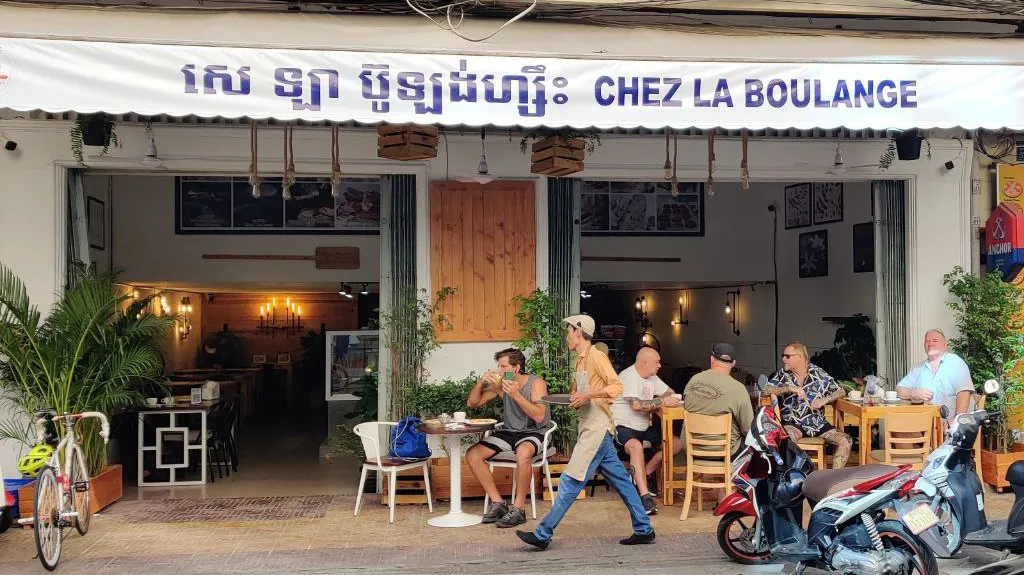
And for the bread itself, Chez La Boulange (12Eo Street 172) opens at half past six and runs until eight in the evening, croissants, artisan loaves, tarts, a coffee programme taken more seriously than a bakery strictly needs to. It arrived in 2023 and settled in immediately, which in this neighbourhood is not a given.
Tips for Eating French in Phnom Penh
Book, especially the small rooms. Armand's, Pépé Bistro, La Taverne Royale and Bistrot de la Poste all operate at a scale where two walk-ins can fill the last table. Evening reservations are not a formality here.
Watch the closing days. Several of the best French kitchens shut on Sundays or Mondays, and some (Bistrot de la Poste among them) run a Tuesday-to-Saturday week. Check before you commit to an evening.
Lunch is where the value is. The two- and three-course set menus at midday routinely cost a third of what the equivalent evening à la carte would, and the kitchens do not downgrade the cooking to match. This is the single best piece of advice in this guide.
The delis are worth the detour on their own. Khéma and La Ferme de Bassac both run counters selling imported cheese, charcuterie and bread. If you are assembling a table at home, this is where the city keeps its supplies.
Dress is generally relaxed, with exceptions. Most bistros here will not blink at shorts. The fine dining rooms and the tower restaurants expect a little more, and the room will let you know if you have misjudged it.
Phnom Penh's French dining is not a museum, and treating it as a leftover of the protectorate misses what has actually happened. The kitchens that survive here have had to answer to a city that knows what a good baguette costs and will not be flattered into paying more for a bad one. What that pressure has produced is a scene with unusual honesty in it, chefs who farm their own beef, bistros that change the menu every week because the market changed, brasseries that will sell you the cheese as well as cook with it. Whether the evening ends with a set lunch under the trees at the Institut or a prime rib carved forty-two floors above Sothearos, the food is being cooked by people who have decided, for whatever reason, that this is where they want to be doing it. That decision is on every plate.
Browse every French restaurant in Phnom Penh on BongNham, or read our guide to Italian restaurants in Phnom Penh, the city's other deep European dining tradition. For the altitude end of this guide, Ruby Jack and LUMHOR both feature in our roundup of Phnom Penh's best rooftop bars. Planning a full day of eating? Follow our one-day Phnom Penh itinerary, or trace the colonial architecture that brought this cooking here in the first place with Art, Architecture & Hidden Gems Around the Royal Palace.